 Johannesburg Travel Guide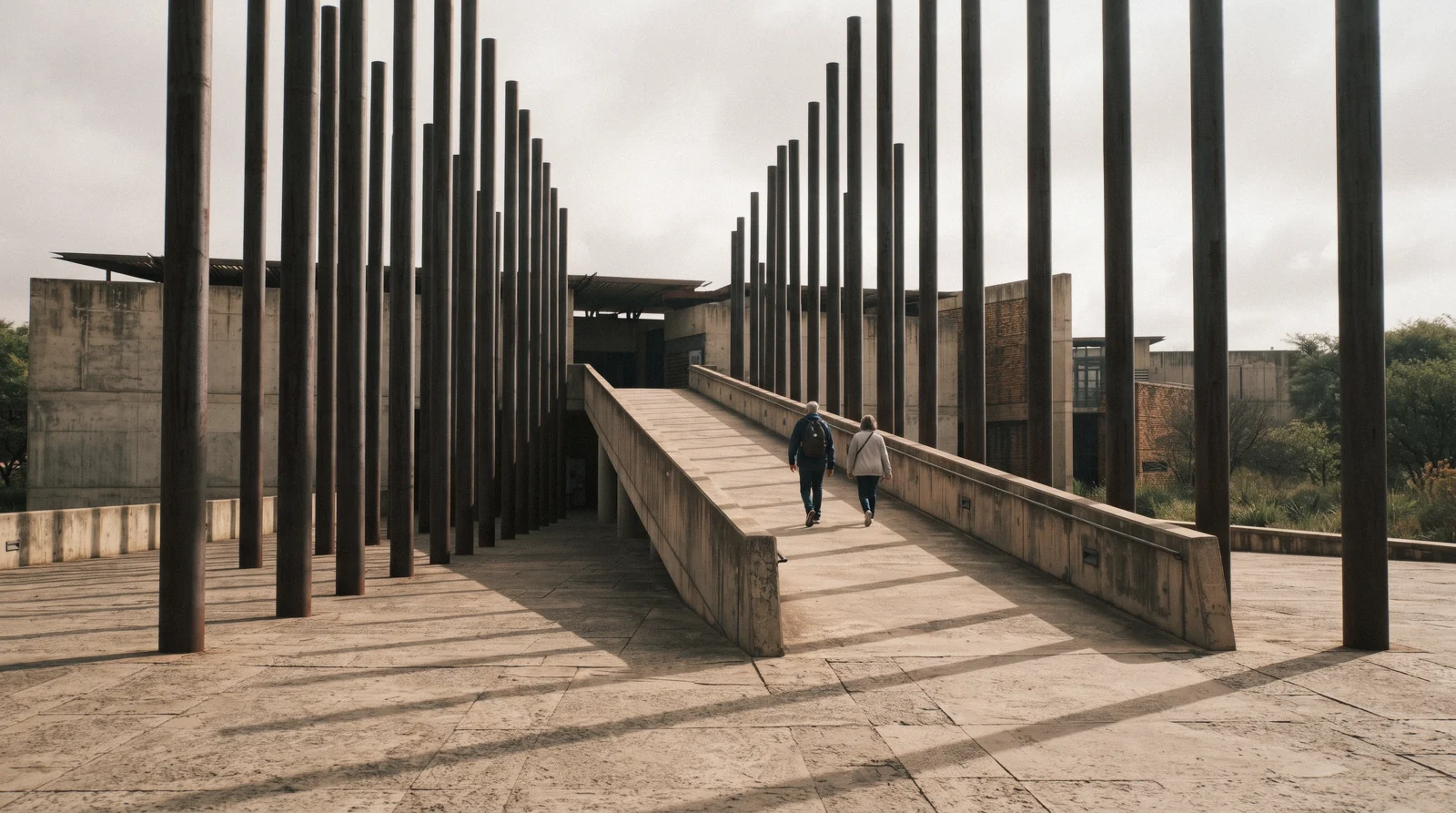
The Apartheid Museum is the museum on the corner of Northern Parkway and Gold Reef Roads in Ormonde, south-west Johannesburg, built to document the rise and fall of South Africa's legalised racial segregation. It opens Tuesday to Sunday 09:00–17:00, closes Mondays, and entry is $14.72 (R240) for international adults with the audio tour included. This page covers the hours, the price schedule in force since May 2026, the classified entrance, and how long to give it; the booking detail lives on the Apartheid Museum tickets page, and if you are weighing it against the Constitutional Court precinct, read Apartheid Museum or Constitution Hill first.
Quick answer Hours, price, the classified entrance, how long, in three lines
The Apartheid Museum opens Tuesday to Sunday, 09:00–17:00, and closes Mondays. Entry is $14.72 (R240) for international adults and $10.43 (R170) for South African adults with ID, audio tour included, with no booking and no time slot — and the museum's own advice is to plan a two-hour visit.
Key takeaways
- No booking is needed for a standard visit: pay at the door or on the museum's Webtickets page. Every rate, including guided-group fares, is on the Apartheid Museum tickets page.
- The museum sits next to Gold Reef City in Ormonde, roughly 30–40 minutes from Sandton by car in normal traffic, and the red City Sightseeing bus stops here — a bus receipt cuts the international adult rate to R220 at the ticket office.
- Most visitors pair it with Soweto: the half-day museum and Soweto tour covers both in 5.5 hours with hotel pickup, or read Apartheid Museum or Constitution Hill if you only have one museum morning.
Apartheid Museum at a glance
Opening hours
| Tuesday–Sunday | 09:00–17:00 |
|---|---|
| Public holidays | Open on most — the official wording is 'most', not 'all' |
Closed Mondays
Admission
- Adult
- $14.72 (R240) international adult, audio tour included; $10.43 (R170) South African adults with ID
- Reduced
- $11.66 (R190) international students, pensioners 60+ and children 7–17; $7.36 (R120) South African concessions with ID
- Free
- No free category for international visitors; free entry for South Africans on Heritage Day (24 September)
Planning it
- Time needed
- Two hours on the museum's own advice; three with the temporary exhibitions
- Book ahead
- Optional — walk-up usually fine
- Address
- Cnr Northern Parkway & Gold Reef Roads, Ormonde, Johannesburg
Apartheid Museum tickets: the official price against the tours
The museum's full price schedule as published on its visitor-information page, with the new rates effective 1 May 2026, next to the three museum-and-Soweto tours our readers book most. Dollar figures use $1 = R16.30; tour prices are the operators' own listed dollar prices.
Do you want the museum on its own terms, or the museum folded into a Soweto day with a driver?
| Option | Price | Includes | Duration | Cancel | Book |
|---|---|---|---|---|---|
| Official ticket — door or WebticketsNearly everyone — the cheapest way in, with no booking and no time slot | $14.72 (R240) international adult; $10.43 (R170) SA adult | Entry plus audio tour | Open-dated; two hours advised | Refund policy not stated | Official site |
| Half-day museum and Soweto tourVisitors without a car who want both halves of the day in one booking | $98 | Museum entry, the Soweto drive past Vilakazi Street and the towers, hotel pickup | 5.5 hours | Free until 24 hours before | Check Availability |
| Guided museum and Soweto tourFirst-timers who want the hardest galleries decoded, not just walked | $91 | Licensed guide through the full museum route, then Soweto's landmarks, hotel pickup | 4.5 hours | Free until 24 hours before | Check Availability |
| Museum, Soweto and city full-day tourOne-day visitors folding the city overview and the museum into a single day | $119.18 | Full-day route with lunch, hotel pickup and drop-off | 8–9 hours | Full refund until 24 hours before | Check Availability |
No Gold Reef City combo is on sale — the museum's official price list links nothing to the theme park next door, so plan them as two separate entries. The SA adult rate requires a South African ID at the desk, and the audio tour is inside every standard rate. Tour prices are the operators' listed figures in Q3 2026.
Museum and Soweto tours compared
All three cards link to the operator's own page, where the date calendar shows what is still open for your day. Ratings are the operators' own.
 from $98
Johannesburg: Soweto & Apartheid Museum Half-Day Tour
Half day built around the museum's full two hours, with a short Soweto drive afterwards for Vilakazi Street and the towers.
Check Availability from $91
Johannesburg: Apartheid Museum & Soweto Guided Tour
Guided full museum route with a licensed guide, then Soweto's landmarks; the strongest museum-first option of the set.
Check Availability from $119.18
Soweto /Johannesburg and Apartheid Museum Guided Full Day Tour
Full day pairing the museum with Soweto by Viator's top-reviewed operator, lunch included.
Check AvailabilityPrices, ratings and details are the platform's own. dollar figures are the listed prices — the platform bills in your account's currency.
What the Apartheid Museum Is
It is the first museum in the world built specifically to document apartheid, and it treats the subject as an argument you walk through, not a cabinet you look into.
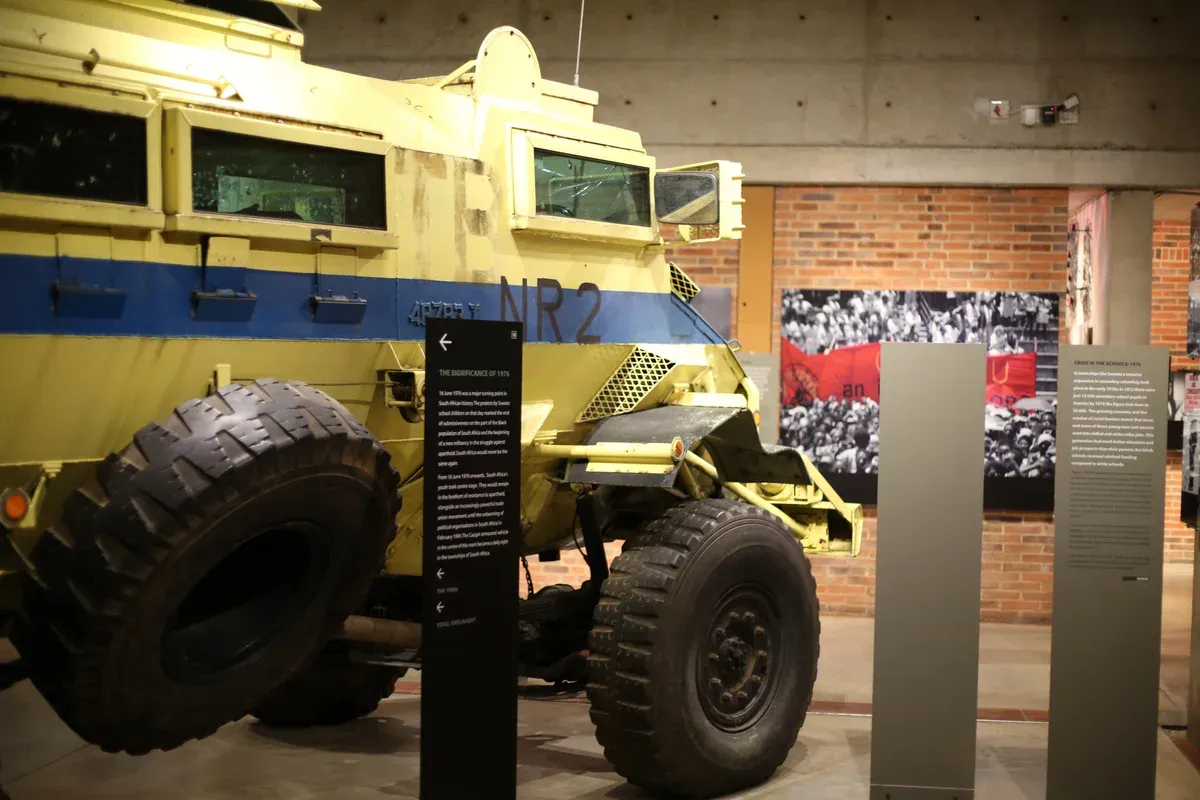
A Casspir armoured vehicle, the security-force transport of the apartheid decades, inside the exhibition. Photo: flowcomm, CC BY 2.0, via Wikimedia Commons
Built with casino money, opened
The museum was established by the Akani Egoli non-profit organisation as part of the development of the Gold Reef City casino, on the seven-hectare site next to the theme park in Ormonde, and it opened. The museum calls itself the pre-eminent museum in the world dealing with twentieth-century South Africa, which is the sort of claim that usually gets trimmed; here the permanent exhibition earns it, because nothing about the building softens the material. The design came from an architectural consortium, and the structure — concrete, steel and a roof of many columns — keeps the galleries dark, narrow and deliberately uncomfortable exactly where the story is.
The route: pillars, classification, journeys, segregation
You meet the Pillars of the Constitution first: seven steel pillars in the courtyard, one for each of the seven values in the South African Constitution — democracy, equality, reconciliation, diversity, responsibility, respect and freedom. Then the Race Classification gallery, which displays the identity documents with which the state sorted every person into white, coloured, Indian or native. Outdoors, the Journeys section lines the path with large portraits of the descendants of people drawn to Johannesburg after the discovery of gold in 1886, hung so you meet them from behind before you meet their faces.
The Segregation gallery then sets the base: from the formation of the Union of South Africa in 1910, official segregation barred black South Africans and women from the vote and laid the ground for what followed.
Beyond the permanent exhibition
The Mandela Exhibition runs alongside the permanent route, and the temporary programme is active: during the check for this guide the museum listed the John Kani exhibition celebrating six decades of performance, playwriting and social justice, a Tutu exhibition, and Time to Act, marking the fortieth anniversary of the United Democratic Front. Temporary shows sit on the route between the permanent galleries, so a two-hour visitor sees some of them whether they planned to or not — which is the argument for the longer routing below.
Exhibition names and founding details from the official site, apartheidmuseum.org, and the museum's visitor-information page, read for this guide
How Much Time to Give the Apartheid Museum
The museum gives its own number — plan a two-hour visit if you want to engage briefly with the exhibitions — which is more guidance than most Johannesburg museums publish. Note that its own guided tours are a group product, pre-booked only and offered to groups of 15 or more, so the guided routing below is a commercial tour. The three routings are ours, built around the museum's figure.
The variable is not distance but weight. The permanent exhibition is a one-way sequence, and the galleries that stop people are the classification entrance, the race-registration documents and the 1976 material. If you schedule under two hours, you will be reading fast exactly where the museum is slow by design.
| Routing | What you get | What it skips | Door to door |
|---|---|---|---|
| The official two hours | The permanent exhibition end to end with the audio tour: classification, journeys, segregation, the uprising years, the liberation settlement | The temporary exhibitions and the memorial gardens | About two hours, as the museum itself advises |
| The half-day version | The permanent route at reading pace, one temporary exhibition, and the Pillars courtyard in daylight on the way out | Nothing you will miss later | Three to three and a half hours, our routing |
| With a guide | The 4.5-hour guided tour walks the museum with a licensed guide, then carries the group on to Soweto | Unhurried reading of every panel | About two hours inside; 4.5 hours door to door |
The Apartheid Museum in Eight Dates
The museum tells a 46-year story; these are the dates the route turns on, ending with its own founding.
-
1948
Apartheid becomes government policy
The National Party wins power on a platform of systematic racial separation, and the laws that define apartheid begin passing from the following year.
-
1950
Every South African is classified by race
The population registration laws sort people into fixed racial categories; the museum's entrance gallery displays the identity documents the system produced.
-
1960
Sharpeville
Police fire on demonstrators protesting the pass laws at Sharpeville, south of Johannesburg; the massacre marks the turn from protest to armed resistance and isolates South Africa abroad.
-
1976
The Soweto uprising
Schoolchildren march against Afrikaans-medium instruction on 16 June and the shooting of Hector Pieterson makes the uprising international news — the full account is on our 1976 page.
-
1990
Mandela walks free
Nelson Mandela is released after 27 years in prison, and the negotiation years that the museum's later galleries document begin.
-
1994
The first democratic election
All South Africans vote together for the first time; apartheid is dismantled as a legal system.
-
1996
Seven values enter the Constitution
Democracy, equality, reconciliation, diversity, responsibility, respect and freedom — the seven values the museum's courtyard carries as seven steel pillars.
-
November 2001
The museum opens
Built by the Akani Egoli non-profit as part of the Gold Reef City casino development, it is the first institution in the world created specifically to document apartheid.
Dates as presented in the museum's permanent exhibition and the standard historical record; founding details from apartheidmuseum.org and the museum's visitor pages, read for this guide.
Hours, Closed Days and the Quiet Slots
The museum is open Tuesday to Sunday from 09:00 to 17:00 and closes every Monday. Public holidays run on the official formula of "most public holidays", which is the museum's own wording — there is no published exceptions list, so check the site in the week you travel. The museum publishes no last-entry time either; with closing at 17:00, an arrival by 15:30 protects the two hours the museum itself asks for.
Two days behave differently from the rest. Heritage Day, 24 September, is free for South African citizens and is the busiest day on the calendar — a fine day to be inside the museum among Joburg families, a bad day to be in a hurry. And because schools book four to six weeks ahead, term-time weekday mornings are given over to school groups; the galleries empty noticeably after 13:00.
- Emptiest: weekday afternoons outside school holidays, and Sunday mornings before the tour buses
- Busiest: Heritage Day (free entry for South Africans) and term-time weekday mornings
- No last-entry time is published — the 15:30 arrival rule is ours, not the museum's
The Classified Entrance, and Getting There
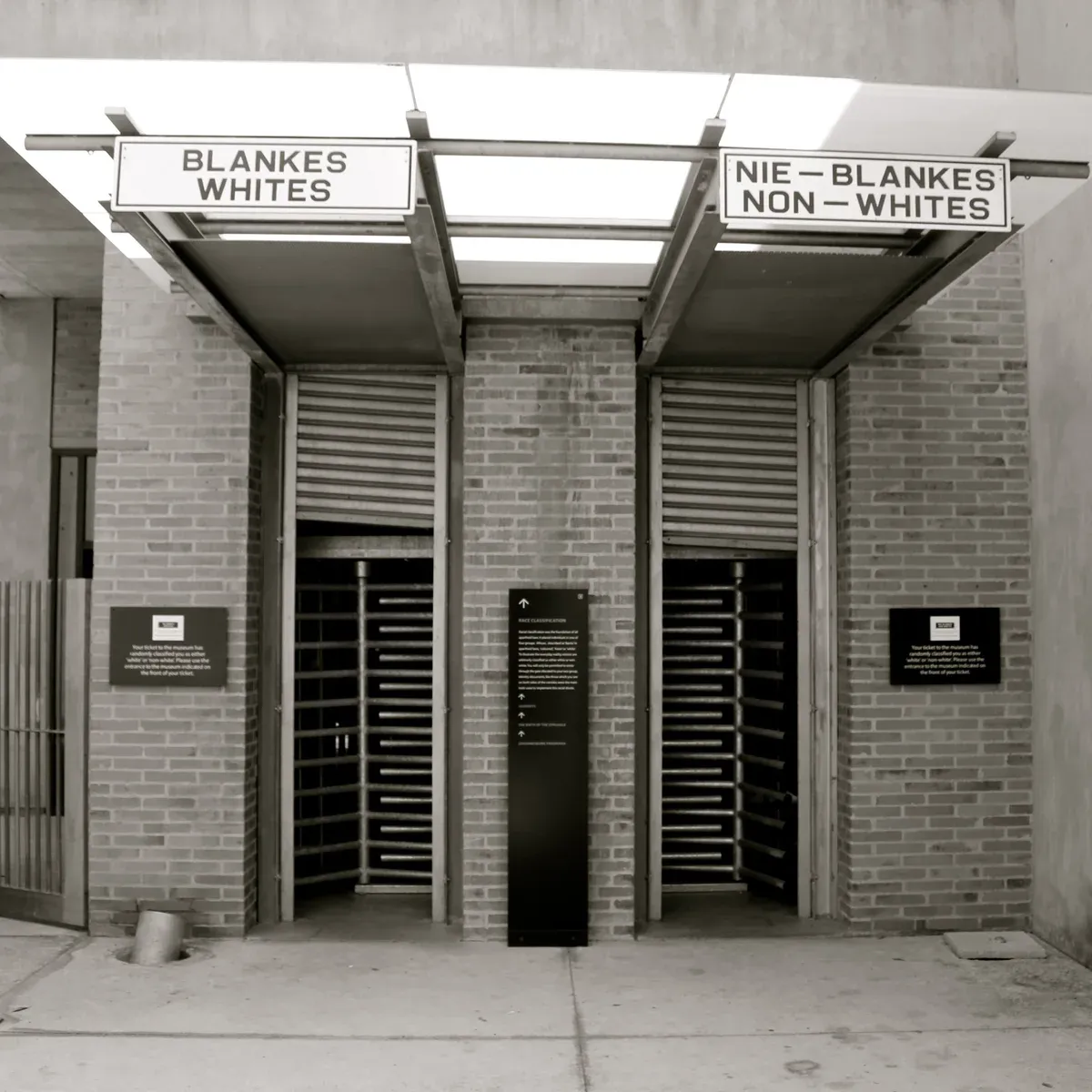
The classified entrance: your ticket assigns white or non-white and the doors enforce it. Photo: Annette Kurylo, CC BY-SA 3.0, via Wikimedia Commons
You will be sorted at the door
Your entry ticket is issued at random as "white" or "non-white", and the two doors are segregated, exactly as public entrances were under the pass laws. The route each door leads you through differs before the streams merge, so what you see first depends on the piece of paper at the gate. Visitors regularly describe it as the moment the museum stops being abstract; treat the ticket as the first exhibit, read the category you were assigned, and use the door it names.
There is no way to opt out, and that is the point.
Getting to Ormonde
The address is the corner of Northern Parkway and Gold Reef Roads, Ormonde, immediately next to the Gold Reef City complex, and the museum sits on the City Sightseeing red bus route. If the bus is how you arrive, keep the receipt: the museum's own ticket office discounts the international adult rate to R220 on presentation of a red bus booking receipt. By car, budget 30–40 minutes from Sandton in normal traffic and allow more at Friday peak; the museum's pages publish no parking guidance of their own, so the Gold Reef City parking next door is the practical fallback.
The museum answers on +27 11 309 4700 and info@apartheidmuseum.org.
- Address: Cnr Northern Parkway & Gold Reef Roads, Ormonde, Johannesburg
- Red bus: City Sightseeing stops here; a receipt cuts the international adult rate to R220
- Parking: nothing published by the museum — use the Gold Reef City complex next door
- GPS: −26.2376, 28.009 (the map embed on the official page centres in the wrong place; trust the coordinates)
Entrance mechanics, red bus rates, address and contact from the official visitor-information page, apartheidmuseum.org; GPS from Wikipedia
Five Things Most Visitors Do Not Know About the Apartheid Museum
All five change something practical about the visit, and each one is checkable on the museum's own pages.
- The admission price is not a bare entry fee. Every standard rate carries the audio tour — the R240 international and R170 South African headline prices both say "including audio tour" on the official schedule, so do not pay extra for one at the door [official visitor-information page]. - The entrance will classify you. A randomly issued ticket marks you "white" or "non-white" and sends you through the matching segregated door, and the two routes show different material before the galleries merge [the museum's entrance sequence]. - The museum exists because of a casino licence. It was established by the Akani Egoli non-profit as part of the Gold Reef City casino development and opened as the first institution built specifically to document apartheid [museum site; Wikipedia]. - There is no Gold Reef City combo ticket. Nothing on the official price list links the museum to the theme park next door, so budget two separate entries rather than hunting for a bundle that is not sold [official visitor-information page]. - The museum itself advises against bringing under-11s. The content is officially deemed unsuitable for children below that age, and school groups — the museum's core youth audience — start above it, booking four to six weeks ahead at R60 per learner [official school-visits page].
At the Apartheid Museum: Dos and Don'ts
Every line here is a decision argued somewhere above, compressed for the morning you go.
Do
- Arrive by 15:30 if you want the full two hours — closing is 17:00 and no last-entry time is published
- Collect the audio tour at the desk; it is already included in every standard rate
- Read the classified ticket you are handed and use the door it names — it is the first exhibit, not a queue problem
- Buy at the door or on Webtickets; a standard visit needs no booking and holds no time slot
- Pair the museum with Soweto the same day — the half-day museum and Soweto tour does both with hotel pickup
Don't
- Don't plan a Monday — the museum is closed, and Constitution Hill is the daily-open alternative
- Don't bring children under 11; the museum officially deems the content unsuitable for them
- Don't hunt for a Gold Reef City combo — none is sold, so plan two separate entries
- Don't arrive at 16:15 expecting the permanent exhibition; an hour is not enough for a one-way route
- Don't pay a reseller for skip-the-line access; there are no time slots to skip
Apartheid Museum map: the Ormonde cluster and the Soweto pairings
The museum, the theme park next door, and the three Soweto and inner-city stops most visitors pair it with.
- 1 Apartheid Museum, Cnr Northern Parkway & Gold Reef RoadsMain entrance off Gold Reef Roads; the classified-ticket doors are the start of the route. Closed Mondays.
- 2 Gold Reef CityTheme park and underground mine tour next door. No combo ticket with the museum — sold separately, and closed Mon–Tue.
- 3 Mandela House, 8115 Vilakazi Street, SowetoThe house Nelson Mandela lived in before prison, a short drive west of the museum; small rooms, big queue mid-afternoon.
- 4 Hector Pieterson Memorial & Museum, Orlando WestThe 1976 uprising memorial on Khumalo Street, minutes from Vilakazi Street; the museum's own 1976 gallery sets it up.
- 5 Constitution Hill, 11 Kotze Street, BraamfonteinThe prison-turned-constitutional-court, open daily including Mondays — the natural substitute when the Apartheid Museum is shut.
Numbers match the pins on the map.
Next stop from the Apartheid Museum
Drive minutes are our estimates in normal traffic; the museum sits inside a cluster that pairs naturally into one day.
Gold Reef City
The theme park and its underground mine tour share the parking with the museum. The mine tour alone is R150, general admission with the tour R355, tickets online only, and the park closes Mon–Tue — so check days before assuming the afternoon continues there. Gold Reef City guide.
Next door Read the guideConstitution Hill
The courtroom built on the old number four prison in Braamfontein, open daily 09:00–17:00 with guided tours from R150 — and it opens Mondays, which is exactly when this museum does not. Constitution Hill guide.
About 20 min by car Read the guideSoweto: Vilakazi Street and Orlando West
Mandela House on Vilakazi Street (R105 South African adults, R185 international) and the Hector Pieterson Memorial sit minutes apart. First time in a township, go with a guide — the guided museum-and-Soweto tour strings the whole day together. Soweto guide.
About 15 min by car Read the guideApartheid Museum questions
Is the Apartheid Museum worth it?
Yes. It was the first museum in the world built specifically to document apartheid, the classified entrance makes the system physical in the first five minutes, and the audio tour is inside the $14.72 (R240) ticket. Two hours is the ask, and most visitors find the 1976 galleries the part they did not expect. If your day is short, the half-day tour with Soweto is the efficient version of the visit.
How long does it take to see the Apartheid Museum?
The museum's own advice is to plan a two-hour visit for the permanent exhibition. Add an hour for the temporary shows and the gardens — the half-day routing above — and a guided visit runs about two hours inside before the tour moves on to Soweto.
Is the Apartheid Museum open on Mondays?
No. Opening days are Tuesday to Sunday, 09:00–17:00, plus most public holidays. On a Monday, Constitution Hill runs its daily tours and is the standard substitute; Gold Reef City next door also closes Mondays and Tuesdays.
What is special about the Apartheid Museum?
Three things: it was the first institution anywhere built specifically to document apartheid; the entrance randomly classifies you "white" or "non-white" and routes you through segregated doors; and the courtyard carries seven steel pillars, one per value in the South African Constitution, which the exhibition then spends two hours earning.
Is apartheid still legal in South Africa?
No. The legal system of racial segregation was dismantled through the negotiations of the early 1990s, the first democratic election came in 1994, and the 1996 Constitution — whose seven values stand as the pillars in the museum's courtyard — is the law of the country. The museum documents the system; it is history, not current law.
How much does the Apartheid Museum cost?
$14.72 (R240) for international adults and $10.43 (R170) for South African adults with ID, audio tour included, on the schedule effective since May 2026. Concessions are R190 international and R120 South African; guided group rates and school fees are on the tickets page.
Is the Apartheid Museum suitable for children?
The museum's own position is that the content is unsuitable for children under 11, and it is explicit about that on the visitor-information and school-visits pages. Teenagers handle the route well, and the audio tour helps them set their own pace; school groups visit from that age with bookings made four to six weeks ahead.
Where is the Apartheid Museum located?
At the corner of Northern Parkway and Gold Reef Roads in Ormonde, immediately next to Gold Reef City, south-west of the city centre — GPS −26.2376, 28.009. It is roughly 30–40 minutes from Sandton by car in normal traffic, and the City Sightseeing red bus stops at the gate.
Where the Apartheid Museum Fits in a Johannesburg Day
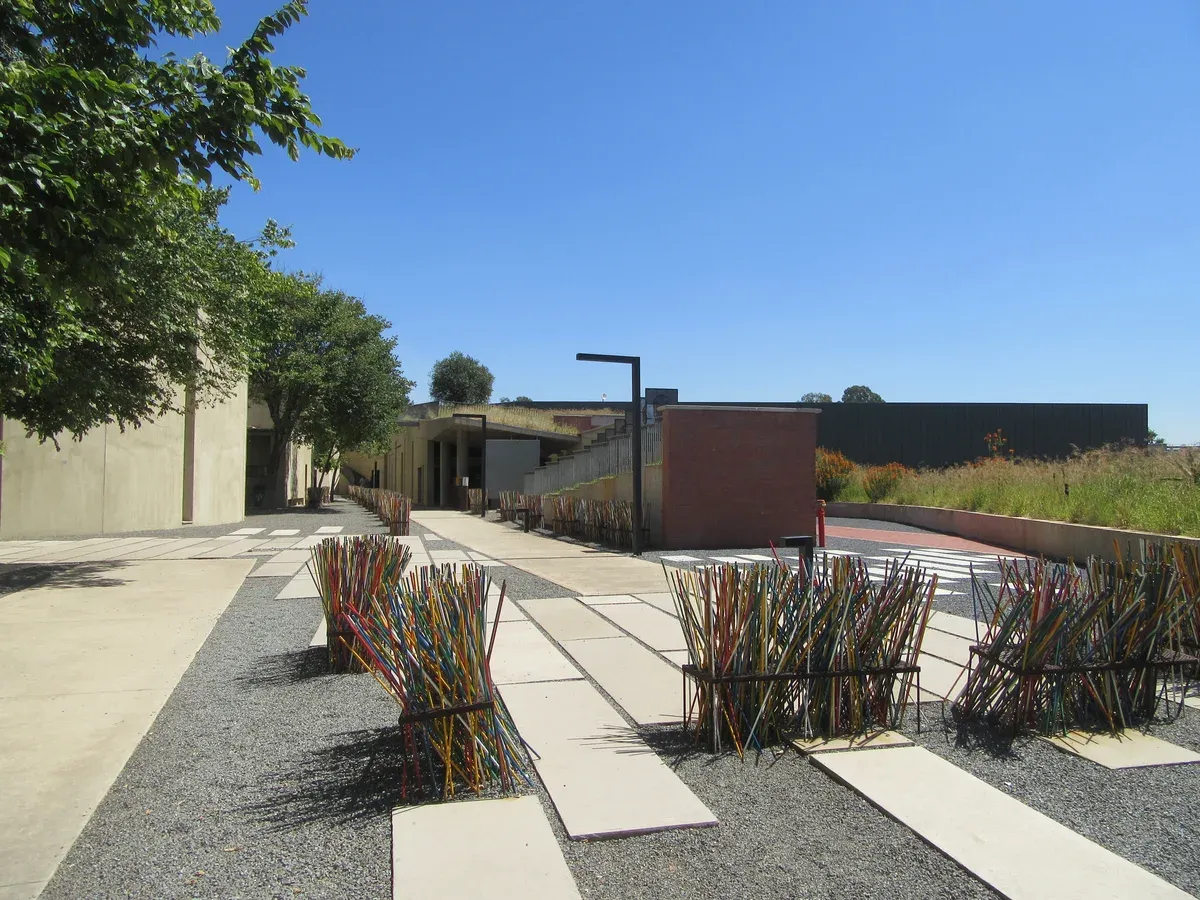
The gardens on the museum's grounds, where most visitors decompress after the route. Photo: amanderson2, CC BY 2.0, via Wikimedia Commons
Take the museum at opening, 09:00, and you are back outside at 11:00 with the classified entrance behind you before the school groups arrive. The natural afternoon is Soweto — Vilakazi Street and the Hector Pieterson Memorial are 15 minutes west — and the theme park next door covers the family version of the day on its own opening days. If you are stringing the city together, the one-day Johannesburg itinerary builds a morning around exactly this sequence, the things to do list ranks the rest of the city by time needed, and every other collection in town with hours and prices is indexed on the museums page.
The full Johannesburg city guide starts from the homepage. Between the museum and the theme park, the memorial gardens are the quietest 15 minutes of the Ormonde cluster.
The Apartheid Museum on Film: the Route, the Galleries, the Entrance
Three walk-throughs that show what the building actually does to you — the classified entrance, the density of the galleries and the pace of the route. Watch one before you go and the two-hour routing above makes sense.
Uncover the Truth: Apartheid Museum Tour in South Africa | Travel Video
A full walk of the permanent exhibition in route order — the closest preview to the two-hour visit.
Video: Fit Time TravelersInside the APARTHEID MUSEUM: A Journey Through South Africa's History
A recent walkthrough of the galleries, useful for judging how heavy the route is before you bring the family.
Video: The TMax TravelsApartheid Museum in Johannesburg, South Africa
An older but clear exterior-and-interior pass that shows the columned facade and the entrance sequence.
Video: ExoTravelsVideos load from YouTube only when you press play.
Prices, hours and terms are set by the venue or operator and confirmed at checkout.
We may earn a commission if you book through one of our links, at no extra cost to you. Full affiliate disclosure