 Johannesburg Travel Guide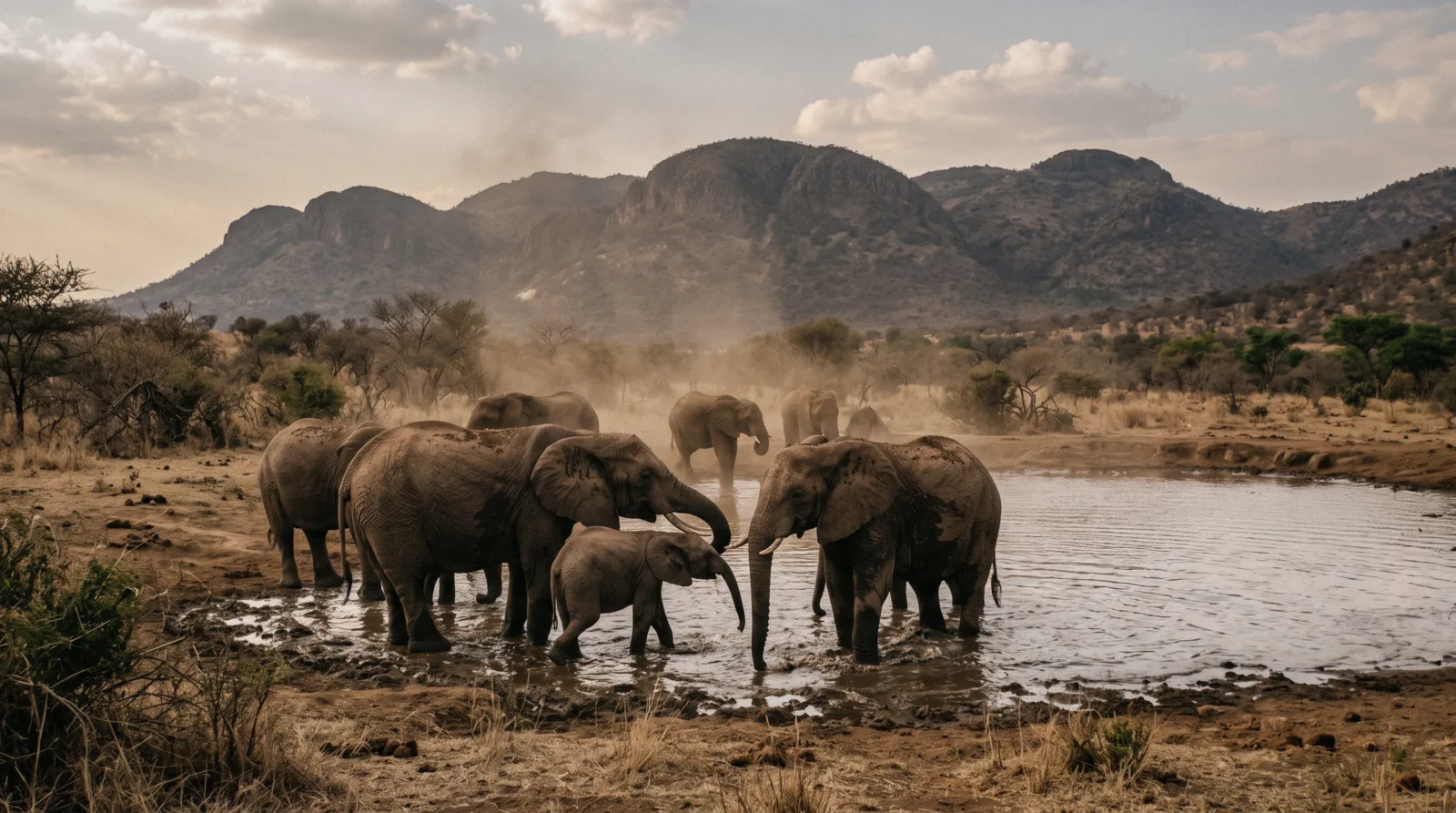
The Pilanesberg day trip from Johannesburg is the answer to the question every visitor to this city asks first: where can I see the Big Five without flying to Kruger? The park fills the floors of a 1,200-million-year-old extinct volcanic ring about two and a half hours from Johannesburg, it is malaria-free, and it lets you drive your own car between the lions. It also runs a dual tariff that most guides whisper about and few print: an international adult pays $45.9 (R748) at the gate while a South African citizen pays $10.31 (R168). This page prints both grids, explains who pays which and why, times your gates by season, and settles the self-drive-versus-tour question with numbers. Prices are the official rand figures converted at $1 = R16.30. For the wider radius, start at the day trips from Johannesburg hub.
Quick answer The fee that decides it, the drive, and the pick — in four lines
A Pilanesberg day trip from Johannesburg puts you in a malaria-free Big Five park inside an extinct volcanic ring about 2.5 hours from the city. The gate charges an international adult $45.9 (R748) and every car $10.31 (R168), while South African citizens pay $10.31 (R168) — passports are checked at the gate. The park allows full self-drive, and gate times run seasonal, opening as early as 05:30 in summer.
Key takeaways
- Car-less or first-safari visitors should book the full-day guided safari with hotel pickup — about 12 hours end to end, rated 4.76 by 1,582 reviewers, free cancellation up to 24 hours
- Self-drivers and fee-planners: the entire dual tariff, vehicle fees and seasonal gate grid are printed in the tables below, with the sourcing caveat every other page omits
- Sun City sits on the park's southern border — an afternoon there runs from $24.2 (R395) day-visitor, TicketPro only; the honest Kruger comparison lives at Pilanesberg or Kruger
Key facts
Opening hours
| 05:30–19:00 | |
| 06:00–18:30 | |
| 06:30–18:00 | |
| 06:00–18:30 |
Closed None — the park is open year-round and markets itself as malaria-free
Admission
- Adult
- $45.9 (R748) international; $23.6 (R385) SADC nationals; $10.31 (R168) SA citizens
- Reduced
- $16.87 (R275) international child 5–12; $5.15 (R84) SA child and pensioner; vehicle fee $10.31 (R168) car up to $35.5 (R578) bus
- Free
- No free tier — the grid starts at age 5 and prints no under-5 rate; the [full grid with the sourcing caveat](#tickets) is tabled below
Planning it
- Time needed
- A full day: about 12 hours hotel-to-hotel on a guided tour, 8–10 hours self-drive from Johannesburg including the drives
- Book ahead
- Optional — walk-up usually fine
- Address
- No street address is published; the park sits in the North West Province next to Sun City, entered through five public gates plus the private Black Rhino Reserve gate — navigate to the park boundary and follow signage to the nearest gate
Every rand the gate can charge you, in the order you meet them: the per-person conservation fee first (one of three tiers, decided by your passport), then the vehicle fee, then the two guided tours that bundle the transfer from Johannesburg. Converted at $1 = R16.30 from the tariffs page and the platforms' listed prices.
Passport and own car at the gate, or one price for pickup, guide and vehicle?
| Option | Price | What you get | Cancel | Book |
|---|---|---|---|---|
| Conservation fee — internationalAny visitor whose passport is not from SA or SADC — this is the row most international readers pay | $45.9 (R748) adult; $16.87 (R275) child 5–12 | Day access for passport holders outside SADC; the rate the gate applies after checking ID | Gate purchase — nothing to cancel | Official site |
| Conservation fee — SA citizensSouth African residents; the pensioner rate matches the child rate, which surprises everyone | $10.31 (R168) adult; $5.15 (R84) child 5–12; $5.15 (R84) pensioner | The local rate for citizens and permanent residents — ID may be requested at the gate | Gate purchase — nothing to cancel | Official site |
| Conservation fee — SADC nationalsRegional travellers from SADC countries who carry that passport | $23.6 (R385) adult; $16.87 (R275) child | The middle tier for Southern African Development Community passport holders | Gate purchase — nothing to cancel | Official site |
| Vehicle feeSelf-drivers only; tour prices already carry the vehicle | $10.31 (R168) car; $15.46 (R252) combi; $19.33–$28.34 (R315–R462) minibus; $35.5 (R578) bus; $19.33 (R315) caravan | One charge per vehicle on top of every occupant's conservation fee | Gate purchase — nothing to cancel | Official site |
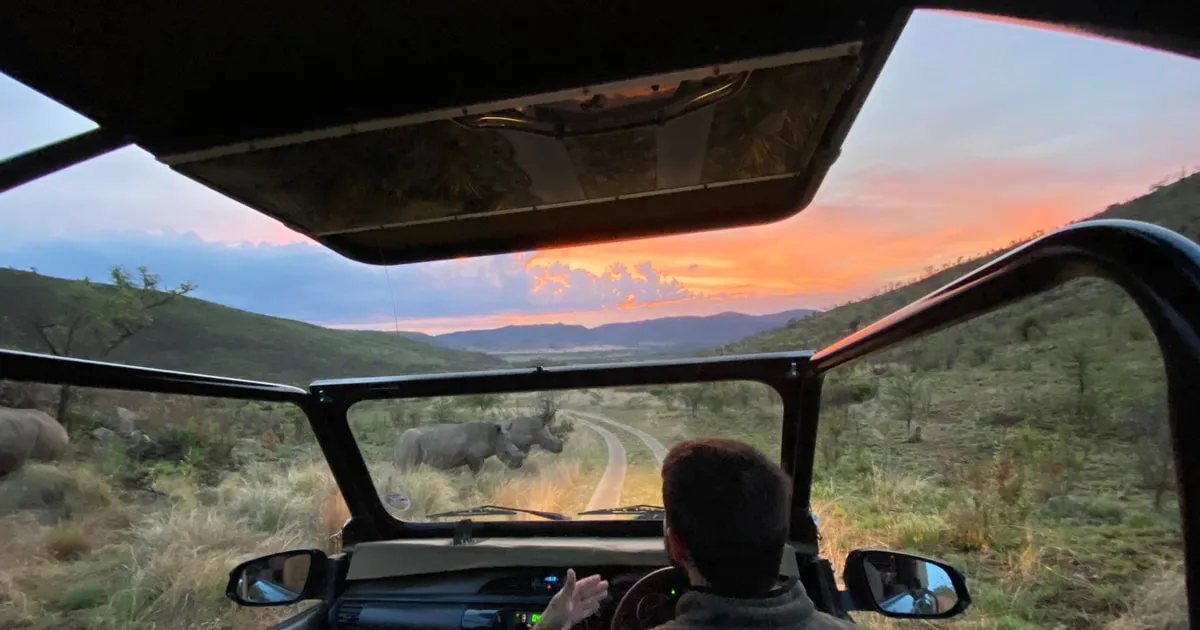
| Full-day guided safari from JohannesburgCar-less visitors and anyone who wants a spotter's radio network instead of luck | $184 | Hotel pickup, about 12 hours door to door with game drives inside the park; rated 4.76 by 1,582 reviewers | Free up to 24 hours before | Check Availability |
| Ultimate full-day safari, Joburg or Pretoria pickupPhotographers who want the open vehicle, and Pretoria-based visitors | $187.87 | About 10 hours with open-vehicle game drives; rated 4.85 by reviewers on the platform | Per the operator's policy on the listing | Check Availability |
The tariff source needs a warning the other guides delete: the figures come from pilanesberggamereserve.com, a booking site that states it is not affiliated with the North West Parks and Tourism Board, and the park-authority domain was unreachable when we checked in Q3 2026 — treat the numbers as near-official and ask at the gate if they differ. The rand is the official currency here; children under 5 are not listed in the tariff grid at all.
Guided safari days from Johannesburg, compared
Both cards include the Johannesburg transfer and the park's game drives; the operator's calendar shows live availability for your date. Platform prices in dollars, as listed at the time of writing.
 from $184
From Johannesburg: Pilanesberg Nature Reserve Game Safari
The Big Five day out: Pilanesberg's extinct volcano ring, in the park before the heat, back in the city by dinner.
Check Availability from $187.87
Full Day Ultimate Pilanesberg National Park Safari from Johannesburg or Pretoria
Viator's full-day Pilanesberg with an early start and the park's whole southern loop driven.
Check AvailabilityPrices, ratings and details are the platform's own. dollar figures are the listed prices — the platform bills in your account's currency.
What Pilanesberg is: a Big Five park inside a volcano's skeleton
Understanding the shape of the ground explains everything about the driving — why the roads spiral up and over hills, why there is no single 'centre', and why the views appear in rings.
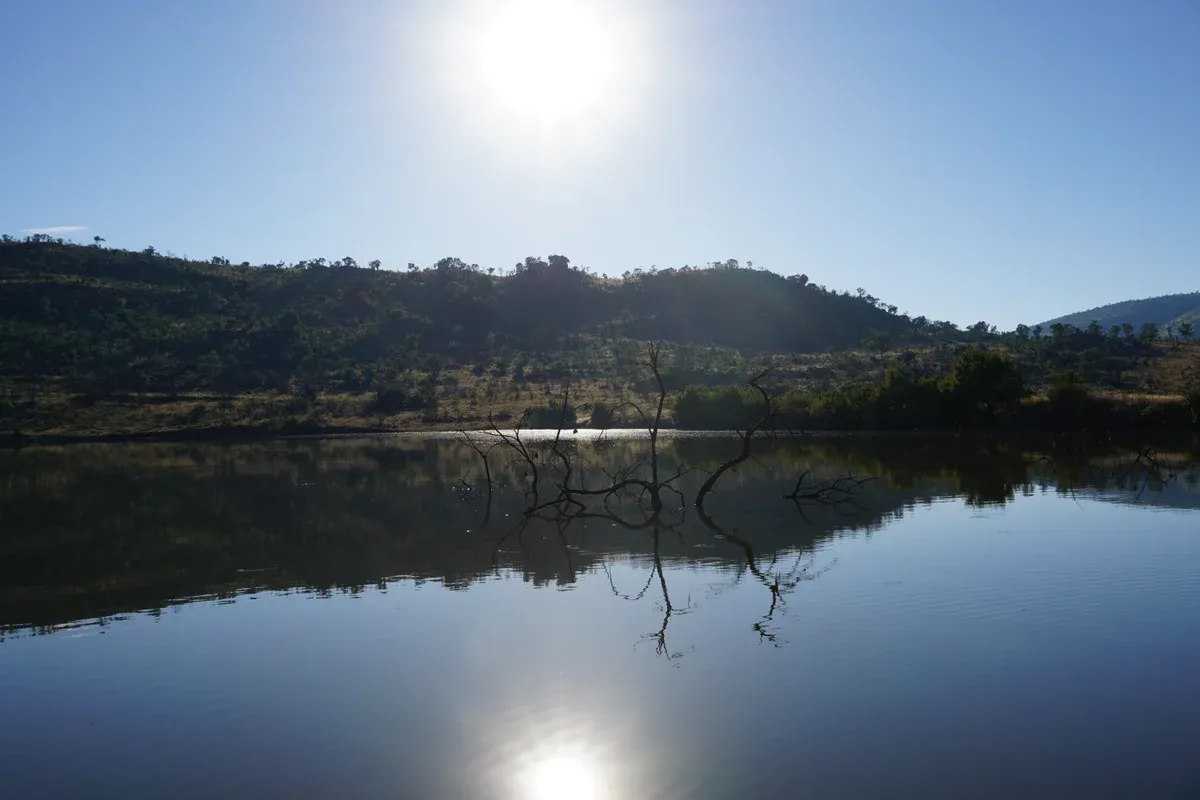
Dawn inside the ring — the hour the gates open and the animals move. Photo: Matt Kieffer, CC BY-SA 2.0, via Wikimedia Commons
The ring in the ground
Pilanesberg is what is left of one of the largest volcanic complexes of its kind on earth: eruptions around 1,200 million years ago built an alkaline ring complex whose caldera has eroded completely away, leaving the ring dykes that once fed it as arcs of hills, including outcrops of rare red syenite. You do not look into a crater here — you drive along the rings of one. The park inside the ring covers 572 km², and its southern fence touches the Sun City resort grounds, which is why the two pair into a single day so easily.
For geology-minded travellers the hills are the attraction in their own right; everyone else should know the ridgelines are where the views — and the viewpoints the self-drive routes climb towards — actually are.
The animals, and where they came from
The Big Five — lion, leopard, rhino, elephant and buffalo — are all present, but none of them are original tenants: the park was stocked from the late 1970s in Operation Genesis, one of the largest game resettlement programmes the country has run, moving some 6,000 animals of 22 species into the newly fenced reserve through the early 1980s. That origin matters practically because it made Pilanesberg the rare Big Five reserve within day-trip range of a major city, malaria-free and open year-round. Expect black and white rhino, elephant herds and buffalo regularly; lion and leopard on their own schedule, best early and late.
The guided tours exist precisely because the animals' habits, not the map, decide the day.
The gate fee: who pays which, and the caveat nobody prints
Pilanesberg runs a three-tier tariff decided by nationality, plus a per-vehicle charge that even tour-bus passengers never see. Here is the full grid, then the sourcing warning that belongs next to it.
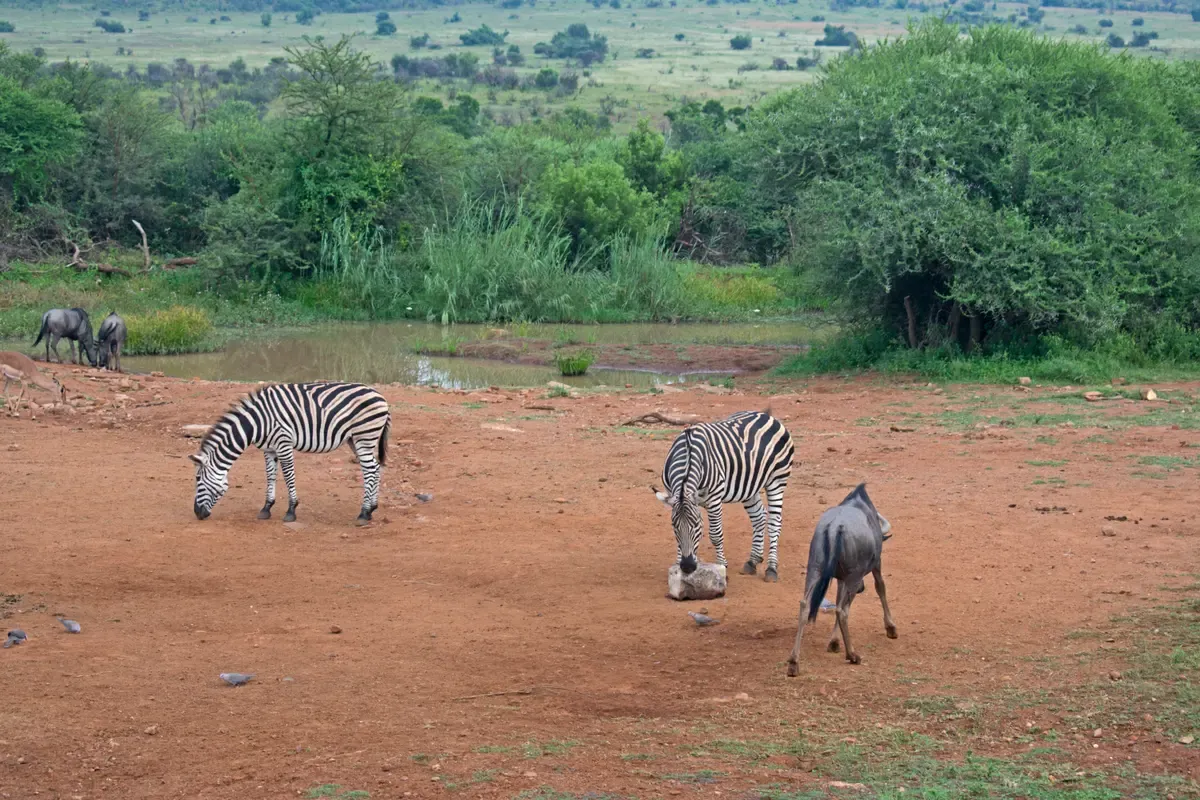
Game on the ring slopes, photographed from the park's central viewpoint. Photo: Ymblanter, CC BY-SA 4.0, via Wikimedia Commons
The three tiers, and the passport check
The rate you pay is decided by your passport, checked at the gate: international visitors pay $45.9 (R748) per adult and $16.87 (R275) per child aged 5 to 12; SADC nationals pay $23.6 (R385) and $16.87 (R275); South African citizens and permanent residents pay $10.31 (R168) and $5.15 (R84), with pensioners at the child rate of $5.15 (R84) — the park says ID may be requested for the local tiers, so carry it. Then comes the charge even locals forget to mention: every vehicle pays its own fee, $10.31 (R168) for a passenger car up to $35.5 (R578) for a bus. A self-driving international couple therefore pays about $102.09 for the day ($45.89 × 2 + $10.31), while the per-person price of a guided tour with pickup already includes the vehicle, the transfer and the guide — do that arithmetic before deciding the tour is expensive.
Where these numbers come from — and why to re-check them
Every figure above was read from the tariffs page of pilanesberggamereserve.com, and the site itself discloses the problem: it is a booking operation that states it is not affiliated with the North West Parks and Tourism Board, the park authority, whose own domain was unreachable when we checked. No other official tariff page for the park was reachable either. That makes these the best published figures available — they circulate as the de facto gate prices — but not authority-signed ones.
The practical protocol: budget to the grid above, carry a card plus some cash margin, and if the gate quotes differently, the gate wins. We would rather print that caveat than a cleaner table we cannot stand behind.
Self-drive or guided safari: the honest comparison
Pilanesberg is one of the few Big Five parks near a major city that openly allows self-drive — the tariff page says game drives run 'self-driven or guided'. Which one you should buy depends on three things: your car, your eyes, and your dates.
Self-drive: the rules and the reality
Any road car copes; the internal network is graded gravel and the ring roads are maintained, so no 4x4 is needed for the public routes. The rules are the standard reserve rulebook — stay in the vehicle except at designated viewpoints and ablutions, keep to the roads, no night driving because the gates enforce closing times. What self-drive costs you is the spotting network: guides in the park radio sightings to each other, which is why tour vehicles so often arrive at a leopard that a self-driver would have driven past.
What it buys you is time at your own pace — you can sit at a waterhole for forty minutes, repeat a loop, and leave when you like within the gate hours. A self-driving international adult pays the conservation fee plus the car: $56.20 in total for one person, or $102.09 for a couple sharing the vehicle fee.
The guided day: what the extra $80–$130 buys
Against that $56.20 DIY bill, the full-day tour at $184 adds hotel pickup from Johannesburg, a driver who handles the 2.5-hour road each way, and a guide whose real product is the radio network and the habit of reading the bush. The open-vehicle variant at $187.87 trades the enclosed transfer vehicle for an open safari seat inside the park, which photographers consistently prefer for the sightlines. The honest decision rule: if nobody in your group has driven in South Africa before, or you are visiting in the five winter months when the 06:30 gate opening means driving rural road in the dark, buy the tour.
If you have a car, a second driver, and a taste for sitting at waterholes, self-drive delivers more hours in the park for a fraction of the price.
Gate hours by season, and the early start that decides the sightings
The gate clock, not the tour brochure, sets the shape of the day. The times shift four times a year with the light, and the animals keep dawn hours in every one of them.
| Months | Gates open | Gates close | What it means for the day |
|---|---|---|---|
| November – February | 05:30 | 19:00 | Longest days; leave Johannesburg by 06:00 to enter near opening and catch the dawn movement |
| March – April | 06:00 | 18:30 | The sweet-spot months — warm, drier, and the dawn start is humane |
| May – September | 06:30 | 18:00 | Cold dawn starts (highveld winter nights sit near freezing) but the driest, clearest game viewing |
| September – October | 06:00 | 18:30 | Spring: thin grass before the rains, some of the year's best sighting odds |
Two practical corollaries. First, the gate close is enforced for everyone including self-drivers — plan the exit drive from your farthest point, because the park is 572 km² and a southern gate from a northern waterhole can eat an hour. Second, the predators' schedule is the real timetable: the first two hours after opening and the last two before closing carry most of the lion and leopard movement, which is why a day that enters at opening, rests through the midday lunch lull at a hide, and drives the last light before the exit gate is the day that works.
Every season's grid above comes from the tariffs page, the same near-official source as the fees — it is the schedule the booking site publishes, and the gates enforce it.
Sun City next door: the afternoon add-on and its TicketPro catch
The resort complex borders the park's southern fence, and pairing them is the classic long day: safari in the morning, wave pool in the afternoon. One administrative detail decides whether that day works at all.
Sun City sells day-visitor tickets from $24.2 (R395) for adults and $17.79 (R290) for children aged 3 to 12, and one ticket covers both the resort grounds and the Valley of Waves water park — there is no separate wave-pool fee. The catch is distribution: tickets are sold through TicketPro and cannot be purchased at the resort, with limited numbers issued daily, so the safari-morning-plus-Sun-City-afternoon plan only works if you buy the day-visitor ticket the night before. Under-2s go free, and the resort's official pages, at suninternational.com/sun-city, carry the current ticket rules — hours are not published there, which is its own kind of answer.
Ignore any link to sunscity.com: that domain has been dead since 2014. The full pairing, with the cost arithmetic for doing both in one self-drive day, is in the day-trips hub pairing table.
The park in time: from eruptions to Operation Genesis
Pilanesberg's story runs in two scales — geological deep time and a hectic fifty years — and every line below is argued from a source named in the note.
-
≈1,200 million years ago
The ring complex forms
Alkaline eruptions build one of the world's largest volcanic ring complexes; the caldera later erodes away entirely, leaving the ring dykes and rare syenite outcrops the park's roads follow today (Wikipedia, "Pilanesberg National Park", fetched 26 September 2026).
-
1979
Fencing and proclamation
Roughly 100 km of fencing encloses the new park in what had been farm and tribal land, setting the 572 km² boundary (Wikipedia, same article).
-
Early 1980s
Operation Genesis
Some 6,000 animals of 22 species are resettled in — described as the largest game resettlement programme in the country's history; the operation featured on the American television series Wild Kingdom in 1981 (Wikipedia, same article).
-
1984
Formal opening
The park is formally opened in April (Wikipedia infobox, same article).
-
1979 onward
A resort grows next door
Sun City rises immediately south of the fence line; the park's southern border today touches the resort complex, making the safari-plus-wave-pool day geometrically inevitable (Wikipedia, same article; ticket rules from suninternational.com/sun-city).
-
Today
The dual-tariff era
Big Five, malaria-free, self-drive allowed, with the three-tier nationality tariff and per-vehicle fees read from pilanesberggamereserve.com's tariffs page — a site that disclaims park-authority affiliation, as flagged in the fees section above.
Geology, 1979 establishment, Operation Genesis, the 1984 opening and the Sun City border come from the Wikipedia article fetched during this page's research; fees, gate times and the self-drive rule from the tariffs page. The relocation history is not documented on any official park domain we could reach — which is itself the finding.
How much time to give Pilanesberg: three routings
The park states no visit length, so these three routings are ours — built on the gate grid, the 2.5-hour road each way, and where each type of traveller actually gets their money's worth.
The variable that decides everything is the road: 2.5 hours each way leaves eight to ten usable hours, and the only question is who controls them. The table splits the three ways the day actually gets spent.
| Routing | What you get | What it costs | What it skips |
|---|---|---|---|
| The guided full day | Pickup at your hotel before dawn, the guide's radio network, two game-drive sessions, back by early evening | $184 pp, free cancellation 24 h out | Waterhole-sitting at your own pace — the group moves on the guide's clock |
| The self-drive long day | Enter at gate opening, the whole ring loop at your pace, lunch at a rest camp, exit at last light | $56.20 solo or $102.09 for a couple (fees + car), plus fuel | The spotting network and the dark-road driving done by someone else |
| The safari-plus-resort day | Morning game drive self-drive, afternoon at Sun City's Valley of Waves on a pre-bought TicketPro ticket | $56.20 gate side + from $24.2 (R395) day visitor | The last-light game drive — the resort closes the safari day early |
At the park: do and don't
Every line compresses a decision argued somewhere above, for the morning you are actually standing at a gate with a passport and a ticket screen.
Do
- Carry the passport of every person in the car — the gate sets your tariff tier from it, and ID may be requested for the SA rates
- Budget the vehicle fee separately: $10.31 (R168) per car on top of every occupant's conservation fee
- Enter at gate opening and plan the last two hours before closing — that is when the predators move
- Book the guided day with free 24-hour cancellation if winter darkness or an unfamiliar road argues against self-drive
- Buy the Sun City day ticket the night before if pairing the resort — TicketPro only, limited daily numbers
Don't
- Don't trust a forum's 'local price' — the $10.31 (R168) rate is for citizens and permanent residents, checked against ID
- Don't leave the vehicle except at designated spots, and don't night-drive: the gate closing is enforced for everyone
- Don't arrive at 10:00 expecting the dawn show — the middle of the day is the animals' siesta
- Don't budget from any single figure you read secondhand, including ours — the tariff source disclaims park-authority affiliation, so let the gate's quote be the final word
- Don't plan the ring loop from gate to farthest waterhole late in the day — 572 km² eats exit time
Five things most visitors do not know
All five come off the tariffs page, the resort's official pages or the geological record — and each one changes something practical about the day.
- SA pensioners pay the child rate. Over-60s with South African ID enter at $5.15 (R84) — half the adult local fee, matched nowhere else in the region's grids [pilanesberggamereserve.com/tariffs-gate-times.html]. - There are six gates, but only five are yours. One of the six belongs to the private Black Rhino Reserve; day visitors use the five public gates, and the tariffs page does not publish their individual coordinates [pilanesberggamereserve.com/tariffs-gate-times.html]. - Day visitors have no rulebook of their own. The park publishes no separate day-visit conditions — you simply pay the per-person fee plus the vehicle fee and keep the gate times [pilanesberggamereserve.com/tariffs-gate-times.html]. - You are never inside a crater. The caldera eroded away completely; the hills are the ring dykes that fed it, which is why the roads climb in arcs instead of descending into a bowl [Wikipedia: Pilanesberg National Park]. - Sun City cannot sell you a ticket at its own gate. Day-visitor tickets — resort and Valley of Waves included — are TicketPro-only with limited daily numbers, from $24.2 (R395) [suninternational.com/sun-city].
Pilanesberg map: the park, its gates and Sun City
The park fills the volcanic ring west of the R55/R565; Sun City sits against its southern fence. The five public gates are not individually mapped by the operator, so the pin marks the park centre — approach by road and follow the gate signage.
- 1 Pilanesberg National Park (centre)572 km² Big Five reserve in the volcanic ring; five public gates, intl fee $45.9 (R748) + $10.31 (R168) per car
- 2 Sun City resortBorders the park's southern fence; day tickets from $24.2 (R395), TicketPro only, never at the resort
- 3 Hartbeespoort (on the return road)The cableway village roughly on the eastern route back toward Johannesburg; closed Mon–Tue
Numbers match the pins on the map.
Park coordinates from Wikidata; Sun City and Hartbeespoort plotted to the resort and cableway village respectively. The tariffs page publishes no gate-by-gate coordinates — navigate to the park boundary and follow signage.
Next stop from the park
Three pairings that hold up after a morning in the ring — each with the fact that decides whether it fits your remaining hours.
Sun City
The resort-and-wave-pool afternoon: day tickets from $24.2 (R395) via TicketPro only, bought ahead. The pairing arithmetic is in the routings table above.
On the park's southern fencePretoria
A different day, not an add-on — but the Pretoria guide matters if you are choosing between the two for a free day: monuments at $22.7 (R370) international versus animals here at $45.9 (R748).
The capital, on the drive home Read the guideHartbeespoort
The cableway over the dam breaks the drive back — if it is Wednesday to Sunday, because the Hartbeespoort guide prints the Monday–Tuesday closure that ruins unprepared plans.
Toward Johannesburg on the eastern route Read the guideCradle of Humankind
The Sterkfontein Caves run guided tours to 15:00, closed Mondays — too late after a Pilanesberg morning, perfect the next day. Costs $9.20 (R150) entry per the Cradle guide.
The eastern side of the return Read the guidePilanesberg questions
How much does it cost to enter Pilanesberg for international visitors?
$45.9 (R748) per adult and $16.87 (R275) per child aged 5–12, plus $10.31 (R168) for the vehicle if you self-drive — so about $56.20 for a solo driver, $102.09 for a couple with a car. The figures come from the tariffs page of pilanesberggamereserve.com, which disclaims park-authority affiliation; treat the gate as the final word. The full grid, SADC and SA tiers included, is in the table above.
Why do South Africans pay less at the Pilanesberg gate?
The park runs a three-tier conservation tariff — international, SADC and South African — a standard structure across the country's public reserves, aimed at keeping the park affordable locally while charging visitors more. The SA rate is $10.31 (R168) against the international $45.9 (R748), and the gate checks ID or passport before applying a tier. Budget on the passport you carry, not the one a forum argued about.
Can you self-drive in Pilanesberg?
Yes — the tariffs page states game drives run 'self-driven or guided', and any road car copes on the graded gravel ring roads. The rules: stay in the vehicle except at designated spots, keep to the roads, and be out by the gate closing, which is enforced. The trade against a guided day is the sightings radio network; the trade for it is your own pace and a bill of about $56.20 instead of $184.
What time do the Pilanesberg gates open and close?
Seasonally: 05:30–19:00 from November to February, 06:00–18:30 in March–April and September–October, and 06:30–18:00 from May to September. The grid is printed in the gate-hours section above, from the same tariffs source as the fees. Enter at opening if sightings are the point — the first two hours carry the predator movement.
Is Pilanesberg malaria-free?
Yes — the reserve is marketed as malaria-free and open year-round, which is precisely why it is the default Big Five day trip from Johannesburg: no prophylactics, no season restriction, no medical preparation. Standard highveld precautions still apply — the CANSA guidance about the region's extreme UV matters more here than any mosquito.
Is a Pilanesberg day trip worth it compared with Kruger?
For a Johannesburg itinerary, usually yes: Kruger needs a flight or a five-to-six-hour drive and at least one overnight, while Pilanesberg delivers genuine Big Five viewing 2.5 hours from your hotel. What Kruger offers in return is scale and wildness that a 572 km² ring cannot. We weigh the trade on its own page at Pilanesberg or Kruger, and if the answer is Pilanesberg, the full-day guided safari is the zero-logistics version.
Can you visit Pilanesberg and Sun City on the same day?
Yes — the resort borders the park to the south, and a self-drive morning game drive followed by a resort afternoon is a workable long day. The prerequisite is the day-visitor ticket, from $24.2 (R395) including the Valley of Waves, bought via TicketPro the night before because the resort does not sell them at the gate and issues limited numbers daily.
Do you need to book a Pilanesberg day trip ahead?
Self-drive needs no booking — the gate sells entry directly. The guided tours are where booking matters: the flagship full-day safari cancels free up to 24 hours before, so the rational move is to reserve early and release late if the weather or your plans turn. The park itself publishes no day-visit booking rule at all, which after the fee-grid caveat should not surprise you.
Pilanesberg on film: the ring, the drives, the sightings
Three clips that show what a day in the ring actually looks like — the landscapes, the roads and the animals at the hours the gates allow.
A Day in Pilanesberg National Park
Exactly the day this page plans — a full circuit of the park from gate opening to the last light.
Video: Biggestleaf TravelA Spontaneous Safari | Pilanesberg National Park
A visitor's safari day, useful for calibrating expectations about sighting frequency on a single visit.
Video: WildWild JourneysPilanesberg Safari at Its Best | Lions, Leopards, Cheetahs & Unreal Sightings
The predator hours on film — what the early-start rule is actually for.
Video: Wildlife Beyond The LensVideos load from YouTube only when you press play.
Prices, hours and terms are set by the venue or operator and confirmed at checkout.
We may earn a commission if you book through one of our links, at no extra cost to you. Full affiliate disclosure