 Johannesburg Travel Guide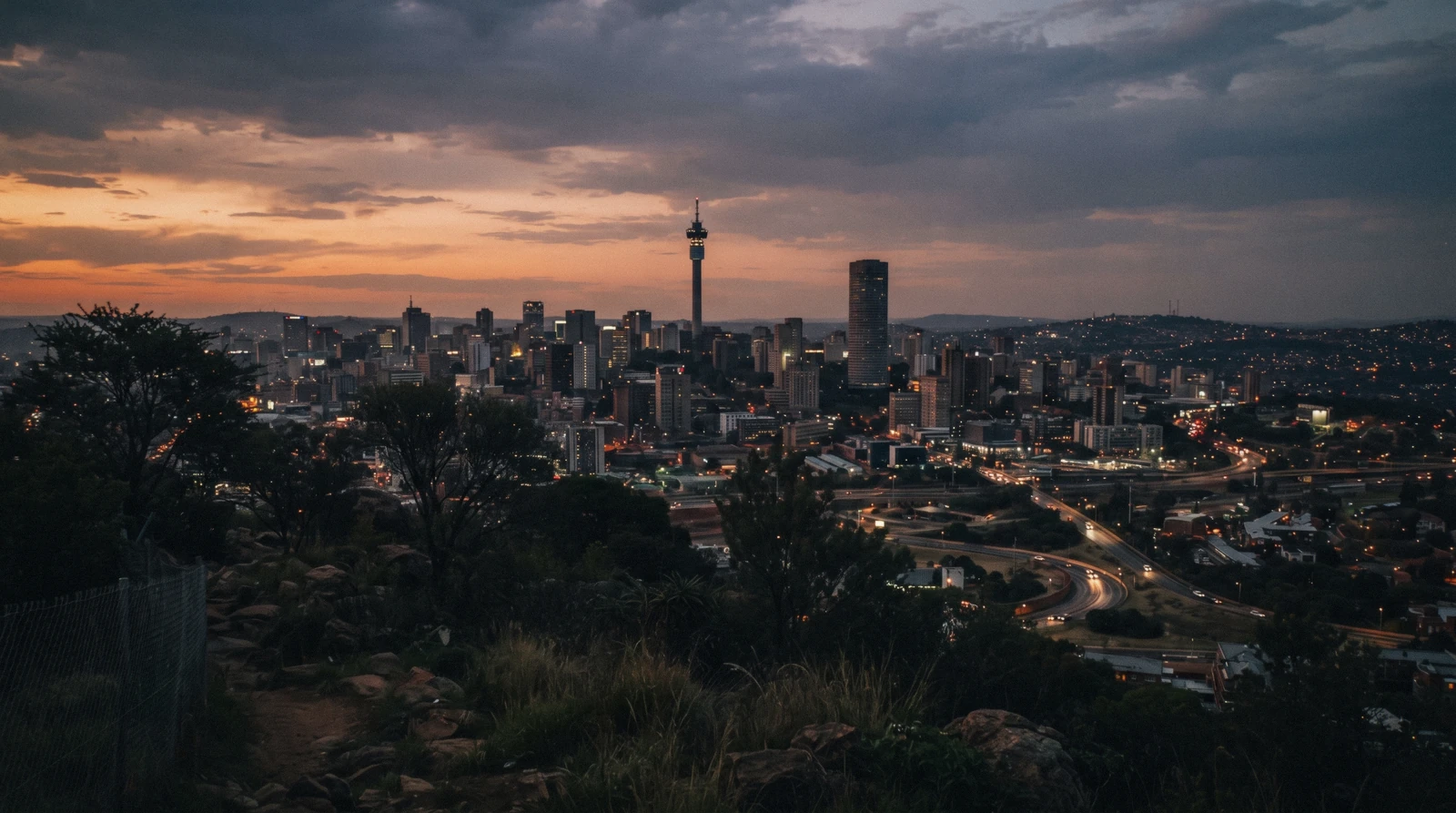
This Johannesburg map puts every place the guide covers on one screen: the history sights with their official adult price, the pins that cost nothing, the two food areas worth naming, the five neighbourhoods, the stations that move you between them and the four day trips inside the frame. Every pin carries a note — what it is and the fact that decides whether to go — and links to the page that explains it. Below the map the same 26 places repeat as a text list, grouped by colour, because a list can be read and a pin cannot. The whole Johannesburg travel guide sits behind it.
Quick answer How the map works, what the colours mean, and what is deliberately not on it
Twenty-six pins in six colours: crimson for the eight history sights, green for the three that cost nothing, bronze for food, teal for the neighbourhoods, grey for the arrival and rail pins, indigo for the four day trips. The view is centred on the city core at (-26.2041, 28.0473), zoom 11, because that is where the pins cluster.
Key takeaways
- The two heavyweights that reward the most planning are both crimson pins: the Apartheid Museum card covers it with Soweto in one run, and the pin list below prints each gate price
- Mondays empty this map: the Apartheid Museum, Gold Reef City and Sterkfontein all shut, and Gold Reef City stays shut on Tuesdays too — the city's sight list is written around that rule
- Three pins cost nothing all year and one more on six public holidays — the free list turns the green row into a whole day
- Five famous names are deliberately absent: the towers, the visitor centre, the closed museum and two unverified markets are named in the gaps block with the reason
The Map: 26 Pins, Six Colours
Numbered pins, filtered by the chips. Tap one for its price and two links: the page on this site that explains it, and the same point opened in Google Maps. The list under the map is the identical set in text, grouped the same way. The four indigo day-trip pins sit up to 40 kilometres out, so they load outside the default frame — filter to Day trips and the map redraws for them.
History sights 8 pins
- Apartheid Museum$14.72 (R240) international adultCheck AvailabilityThe city's defining museum, next door to Gold Reef City in Ormonde. Closed Mondays; the price is the May 2026 schedule and includes the audio tour, and the museum itself deems the content unsuitable for under-11s.
- Constitution Hill$9.20 (R150) highlights tourCheck AvailabilityThe old fort and prison that became the Constitutional Court's home; entry is by guided tour. Individuals need no booking, last tickets go at 16:00, and the site is cashless.
- Mandela House$11.35 (R185) international adultCheck AvailabilityThe red-brick house at 8115 Vilakazi Street where Nelson Mandela lived from 1946 to 1962. Cashless since December 2025, and the venue publishes no opening hours — phone 087 265 2252 before setting out.
- Hector Pieterson Memorial & MuseumThe museum of the 16 June 1976 uprising, on Khumalo Street in Orlando West. The city's own page lists R30 for pensioners and R10 for students but no adult rate and no hours, so this pin carries no price — none is published.
- Gold Reef City$21.8 (R355) rides + mine tourCheck AvailabilityA theme park laid over the old Crown Mines ground, with a real underground mine tour as the headline act. Tickets are online-only, under-4s cannot go down the mine, and the park shuts Mondays and Tuesdays.
- Ponte CityCheck AvailabilityThe hollow 54-storey tower on the Hillbrow ridge, Africa's tallest residential block, revived after its 1990s collapse. You cannot walk in off the street: visits run as small guided groups, so the pin carries a card rather than a gate price.
- Vilakazi StreetFree to walk; the house museums ticketCheck AvailabilityThe Orlando West strip every Soweto visit centres on — Mandela's house at number 8115, with the Hector Pieterson trail a few minutes away. Walking it costs nothing, but the foreign office's line on township visits is to go with a reliable guide, and the guided frames start near here.
- Market TheatreCheck AvailabilityNewtown's famous theatre, opened in June 1976 with its stages named for John Kani and Barney Simon, and a 50th-birthday programme running this year. Show prices move with the programme and sell through Webtickets; the Museum Africa building beside it is closed.
Free 3 pins
- Wits Art MuseumFreeA serious collection of African art on the Braamfontein edge of Wits University, with no admission charge at all. Open Tue–Sat 10:00–16:00 and closed on public holidays.
- Mary Fitzgerald SquareFreeNewtown's open square, named for the striker and unionist who led the 1919 tram boycott, ringed by the old market buildings. The city publishes no visitor information for it — no hours, no management notice — which is why this pin carries no more than it does.
- Nelson Mandela BridgeFreeThe span that carries you out of Braamfontein and over the railway yard into Newtown — the connective tissue between three pins on this map. Daylight crossing only: the foreign office's rule is no walking around after dark, stations included.
Food areas 2 pins
- Market On MainThe food market inside Arts on Main, the restored warehouse that anchors Maboneng — the precinct's own site says Sunday is its busiest day because of it. Stall prices are cash-per-plate and unpublished; come hungry rather than with a budget.
- Nelson Mandela SquareSandton's dining and shopping square under the Mandela statue — the default dinner ground for everyone sleeping in the northern belt. The mall publishes only coarse 09:00–17:00 trading blocks, so individual restaurant hours are not printed here.
Neighbourhoods 5 pins
- BraamfonteinThe student ridge above the CBD: Wits University, the free art museum, Constitution Hill on its edge and Park Station at its foot. This pin marks the suburb, not the Saturday market everyone still lists — that one failed the verification test in the gaps block below.
- Maboneng"Place of light" in seSotho — the retrofitted manufacturing blocks south-east of the centre where the city's regeneration is most visible, and the one pin cluster that works on foot. Sundays are the day; the food market sets the rhythm.
- NewtownThe old market quarter west of the centre: Mary Fitzgerald Square, the Market Theatre and the shuttered Museum Africa. The red bus calls here on its loop, which makes it the easiest suburb to bolt onto a museum morning.
- SandtonThe money district where most visitors actually sleep: the Gautrain's flagship station sits under Rivonia Road with direct trains from the airport, and Mandela Square's restaurants are five minutes away on foot.
- RosebankThe leafy node on the airport line and stop 1 of the red bus, whose tour office sits in The Zone @ Rosebank. The underground Gautrain station on Oxford Road, the art and craft market on Cradock Avenue (09:00–18:30) and the malls sit a short walk apart.
Arrival and rail 4 pins
- O.R. Tambo International AirportGautrain to Sandton $13.99 (R228)Africa's busiest airport, east of the city, with the Gautrain station inside the terminal. The train is the arrival move this guide recommends: the foreign office warns that criminals have followed arrivals from this airport and robbed them later.
- Gautrain SandtonFrom the airport $13.99 (R228)The system's flagship station, underground beneath Rivonia Road with 24-hour security — the northern belt's front door. Trains run 05:06–21:20, and a Gautrain Card costs $1.29 (R21) with a minimum $2.33 (R38) load.
- Gautrain RosebankFrom the airport $13.99 (R228)The underground stop opposite The Zone on Oxford Road, one station closer to the city than Sandton on the same airport line — the right exit for Rosebank's malls and the red bus start.
- Park StationFrom the airport $14.72 (R240)Johannesburg's historic rail terminus and the Gautrain's city-centre stop at the Braamfontein edge. The foreign office says do not walk after dark, including to Gautrain stations — arrive by e-hailing and leave the same way.
Day trips 4 pins
- Sterkfontein Caves$9.20 (R150) adult tourCheck AvailabilityThe Cradle of Humankind's working dig site, about 40 kilometres north-west, reopened under Wits University after two years of upgrades. Guided tours run hourly 09:00–15:00, Tuesday to Sunday; closed Mondays.
- Lion & Safari ParkEntry free; self-drive $24.5 (R400)Check AvailabilityA 1,200-hectare reserve on the R512 towards Hartbeespoort — gate entry costs nothing and you pay per activity, from self-drive to guided drives. Open 08:00–17:00 every day of the year, with lion feeding at noon.
- Lesedi Cultural VillageCheck AvailabilityFive homesteads and a dance show run by aha Hotels near Lanseria, with programmes daily at 11:30 and 16:30. The operator publishes no rand prices online, so the pin carries none — booking happens by phone or through the tour cards.
- Walter Sisulu Botanical Garden$6.13 (R100) peak entryThe Witpoortjie waterfall and a nesting pair of Verreaux's eagles in Roodepoort — the closest green pin to the city on this map. Card or online ticket only, no cash at the gate; open 08:00–17:00 daily.
Pin positions come from each venue's own published coordinates in this site's research packs — operator sites, Wikipedia and Wikidata, OpenStreetMap — read at the last check; the streets, squares and stations that publish no coordinate of their own were geocoded once from OpenStreetMap's Nominatim service and cached into this page. Pin prices are the official adult rand figures, dollar-first at $1 = R16.30; where a venue publishes no price the cell stays empty and the pin note says why.
The Five Pins Worth A Short Visit
A map is an inventory, not a ranking, and this table is not a top five. These are the pins that pay off when you have an hour or two and no mood for planning — with the reason each earned its place and the time it actually takes.
| Pin | Colour | Why it makes the shortlist | Time to give it | Cost |
|---|---|---|---|---|
| Vilakazi Street | History | The highest density of story per metre in the city — Mandela's house and the uprising memorial within a short walk, free to stroll between | 60–90 min | Free to walk |
| Wits Art Museum | Free | A world-class African art collection that costs nothing and never queues; the easiest quality-per-minute pin on the map | 45 min | Free |
| Nelson Mandela Bridge | Free | Walks you between two neighbourhood pins with the mine-dump skyline behind — the city's best fifteen minutes of orientation | 15 min | Free, daylight only |
| Ponte City | History | The single most photographed building in Joburg, and the guided visit is short, small-group and runs most days | About 1 hr | Via the tour card |
| Mary Fitzgerald Square | Free | Pairs with the Market Theatre pin for a Newtown hour; the red bus stops it, so it slots into any loop day | 20–30 min | Free |
Times are this guide's own estimates on the ground rules each venue publishes, not figures the venues state. The heavier pins — the Apartheid Museum, Constitution Hill, Gold Reef City, Sterkfontein — deserve half-days and have their own pages; the itineraries show how they combine. Figures in Q3 2026.
The Cards That Cover These Pins
Five listings between them cover the pins most first visits actually reach: the museum-and-Soweto combination, the Vilakazi Street walk, the Ponte tower, the caves and the lion park. Where a pin's note says the venue publishes no price, the card is also where the honest number sits.
 from $119.18
Soweto /Johannesburg and Apartheid Museum Guided Full Day Tour
Full day pairing the museum with Soweto by Viator's top-reviewed operator, lunch included.
Check Availability from $43
Soweto: Walking Tour with a Local Guide and Lunch
Walk Soweto's streets with a local resident, eat where the neighbourhood eats; the most honest two hours you can buy there.
Check Availability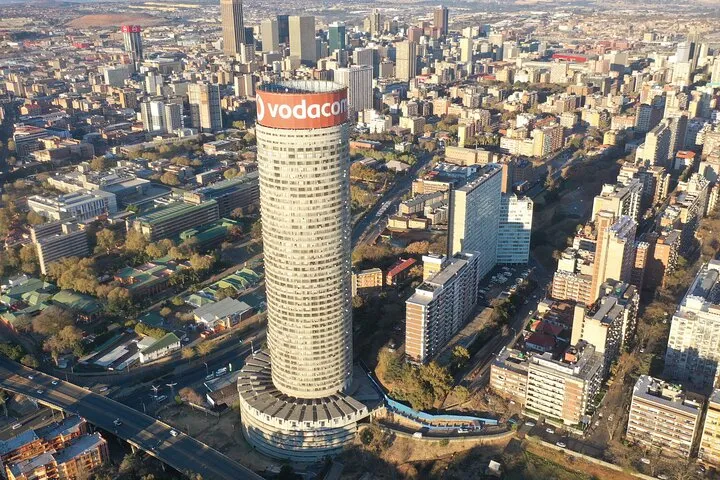 from $31.36
Ponte Experience
Into Ponte City, the hollow cylinder tower: its history, its residents and the view from the top floor.
Check Availability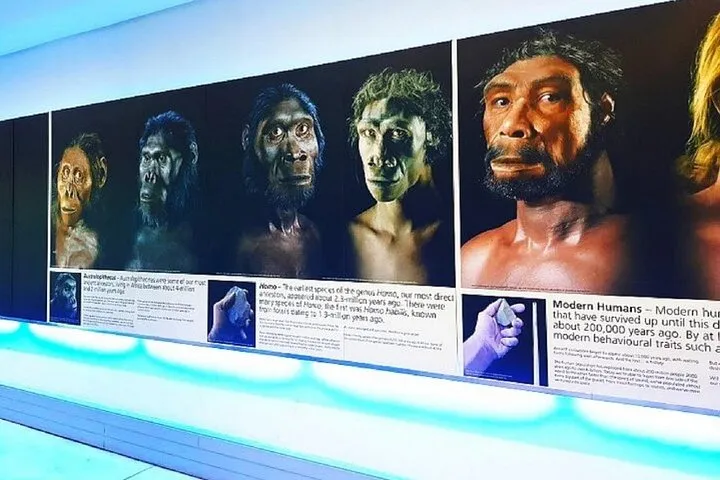 from $116.04
Cradle of humankind & Maropeng/sterkfontein caves tour
Full-day Cradle loop with Maropeng and the caves, the unhurried version for the human-origins curious.
Check Availability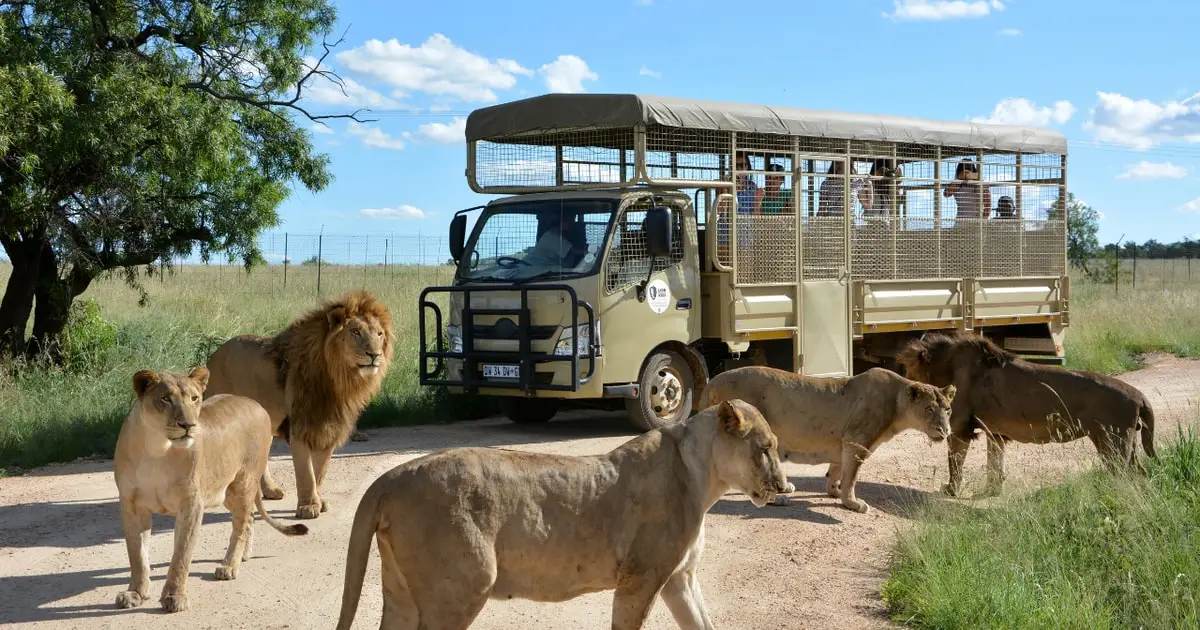 from $143
From Johannesburg: Lion & Safari Park Half-Day Tour
Half day to the Lion & Safari Park: the drive-through enclosures and the cub-free areas, from Johannesburg.
Check AvailabilityPrices, ratings and details are the platform's own. dollar figures are the listed prices — the platform bills in your account's currency.
What The Six Colours Encode
The chips split the pins by the first question a visitor asks, and in this city that question is usually about cost and history rather than geography.
Crimson, history sights. Eight pins where somebody sells a ticket or stands guard over the story: the Apartheid Museum, Constitution Hill, Mandela House, the Hector Pieterson Memorial, Gold Reef City's mine, Ponte City, Vilakazi Street and the Market Theatre. Two of the eight print no price on purpose — the Hector Pieterson's city page lists no adult rate, and Ponte City admits you only on small guided visits — and the pin notes carry those findings instead of a fake number.
Green, free. Three pins that cost nothing on any day: Wits Art Museum, Mary Fitzgerald Square and the Nelson Mandela Bridge. Constitution Hill would join them on six public holidays a year, when entry is free for everyone — which is exactly why those are the crowded days to avoid rather than chase.
Bronze, food areas. Two pins, deliberately areas rather than restaurants: Market On Main in Maboneng, the Sunday market the precinct's own site credits as its busiest draw, and Nelson Mandela Square in Sandton, the default dinner ground of the northern belt. A food pin here vouches for the area's pulling power, not for any particular kitchen — the restaurant-level judgments live on where to eat, which ranks nothing it has not eaten.
Teal, neighbourhoods. The five suburbs with pages of their own: Braamfontein, Maboneng, Newtown, Sandton and Rosebank. Each pin sits on the suburb's practical centre — the station, the square or the mall — because a neighbourhood pin is somewhere you orient from, not somewhere you queue at. The full set is argued as a decision on the neighbourhoods hub.
Grey, arrival and rail. The airport and the three Gautrain stations a visitor uses, with the fare from the airport printed on each pin: $13.99 (R228) to Sandton or Rosebank, $14.72 (R240) to Park. This is the only rail the city has, and it is also the boundary of what the map's public-transport story can promise — the next block explains what the trains never touch.
Indigo, day trips. Four pins inside an hour and a half: the Sterkfontein Caves, the Lion & Safari Park, Lesedi Cultural Village and the Walter Sisulu Botanical Garden. They are pinned despite the distance because they answer the question every Johannesburg planner asks by day three — where does the wildlife and the open air come from. The longer runs, Pilanesberg and Hartbeespoort among them, live on day trips with their own maps.
Prices and rules from each venue's official page in the research pack and the research pack; the FCDO walking rule from the UK foreign-office travel advice of 8 July 2026.
How The City Scatters These Pins
Johannesburg is not a city with a centre and suburbs; it is a ridge with satellite clusters, and once you see the ridge the pin pattern stops looking random.
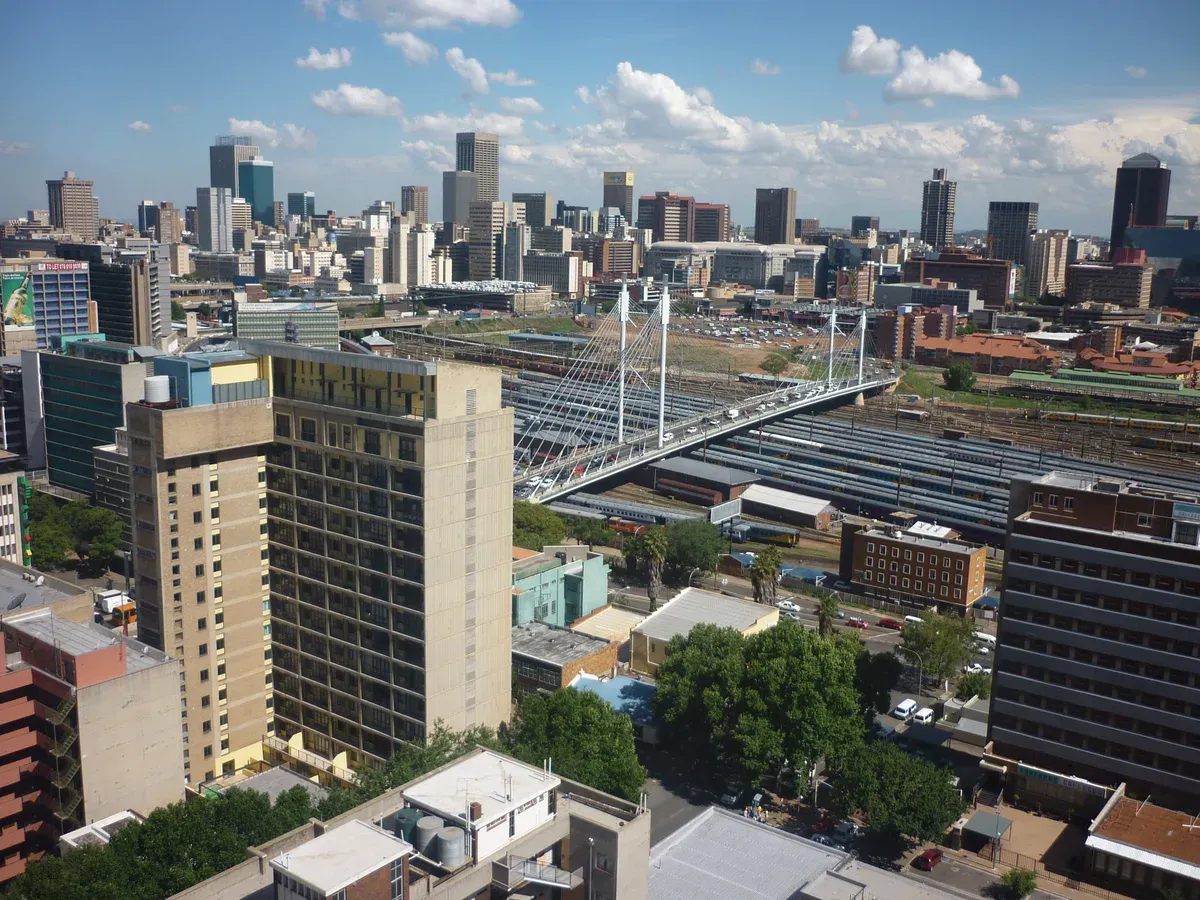
The CBD skyline from the east — the ridge line this section describes. Photo: Evan Bench, CC BY 2.0, via Wikimedia Commons
The city exists because gold was struck on the Witwatersrand in 1886, and the map still reads along that east–west ridge: the CBD grid, Braamfontein and Newtown sit on it, with the mining landmarks — Gold Reef City and the Apartheid Museum on the old Crown Mines ground — at its south-western end. Everything crimson clusters within a few kilometres of this spine, which is why a two-day city plan never needs a car between them, only judgement about which streets to walk.
Soweto breaks the pattern deliberately: a string of townships to the south-west, stitched together since the 1970s into a city of its own, with its three pins — Vilakazi Street, Mandela House, the Hector Pieterson — all inside one walkable Orlando West pocket. The northern belt runs the other way: Rosebank and then Sandton strung north along the rail line the airport train uses, getting wealthier and more self-contained each stop. Between the three clusters lie kilometres of ordinary suburb — that is the distance the map's zoom setting is honest about.
| Pin cluster | Where it sits | Distance reality |
|---|---|---|
| CBD, Braamfontein, Newtown, Ponte City | On the gold ridge, contiguous | Walkable pockets joined by short e-hailing runs |
| Ormonde (Apartheid Museum, Gold Reef City) | South-west end of the mining belt | About 8 km from the CBD — a red-bus stop, not a stroll |
| Orlando West (Vilakazi, Mandela House, Hector Pieterson) | Soweto, south-west of the city | 30–40 min by car from Sandton; one walkable pocket |
| Rosebank and Sandton | The northern belt along the rail line | Minutes by Gautrain, near the airport line |
| The four indigo pins | Outliers: north-west and west | 40 minutes to an hour and a half by road |
The practical consequence: plan the map as three city days plus one outlier day, not as one city with attractions. The one-day itinerary works the ridge, the two-day plan adds Soweto or the north, and the three-day plan spends the outlier day on the Cradle or a reserve.
What No Train Reaches
Johannesburg's rail map is one airport line with three useful stops, and a visitor who assumes it is a metro will misplan the week within an hour of landing.
The Gautrain connects the airport to Sandton, with Rosebank and Park Station between — the grey pins. That is the whole system. No station serves Soweto, none serves Ormonde's museum pair, none runs to the Cradle, Walter Sisulu or Lesedi, and the classic commuter rail that does radiate from Park Station is the service the foreign office explicitly ranks below Gautrain and e-hailing for safety.
The city's bus story is thinner still: Rea Vaya's own website served an expired security certificate all week when this was checked, so its fares could not be verified and no bus pin earns a place on this map.
| Pin cluster | Nearest rail | How you actually arrive |
|---|---|---|
| Soweto's three pins | None | Guided tour with hotel pickup, or e-hailing door to door |
| Ormonde: Apartheid Museum, Gold Reef City | None | Red bus stops 7 and 8, or e-hailing |
| Roodepoort: Walter Sisulu | None | Rental car or a tour; the gate is card-only |
| Cradle of Humankind, Lion Park, Lesedi | None | Rental car or a day tour with transfers |
| Airport, Rosebank, Sandton, Park | Gautrain | The one spine — card or contactless bank card |
The one motorised loop that stitches the crimson and teal pins together is the City Sightseeing red bus: $23.0 (R375) for a one-day hop-on ticket, first departure 09:00 from Rosebank, last 15:00, with thirteen stops from Constitution Hill to Gold Reef City and a Soweto extension leaving the theme park hourly through the middle of the day. Treat it as the map's missing transit layer rather than as a sightseeing indulgence — on a Monday when half the crimson pins shut, the loop alone still earns its fare. The full route logic is on getting around.
The Gaps On This Map, And Why Each One Is A Finding
Twenty-six pins is fewer than other guides advertise, on purpose. Every famous name below failed verification on the check date, and a map that pins what it cannot stand behind is just a directory of other people's claims.
- No pin for the Orlando Towers. The operator's own website served only an "under maintenance / coming soon" page on the check date — no prices, no hours, no booking channel, nothing verifiable about whether the bungee even operates. The two painted cooling towers at the Soweto gates photograph beautifully; this map still refuses the pin until the operator stands behind them again. (orlandotowers.co.za) - No pin for the Maropeng Visitor Centre. Its website is stale or unreachable, no rand price or hours can be verified on any official page, and management of the caves has moved to Wits University.
Sterkfontein gets the pin because Wits runs a live, priced, dated visitor site; Maropeng stays off until it does the same. (maropeng.co.za and sterkfonteincaves.wits.ac.za) - No pin for Museum Africa. 2026 reporting describes the Newtown museum as in upgrade and transition, serving as storage for another collection, with no confirmed public reopening. The Newtown pin marks the building's square; the museum inside it stays unpinned.
(City reporting, 2026) - No pin for the Neighbourgoods Market, Braamfontein. The market operator's own site lists only its Cape Town market; 2026 blog guides still send people to The Playground on a Saturday. An event that has left the official channels does not get a pin that implies it runs. (neighbourgoodsmarket.co.za) - No pin for Regina Mundi. Soweto's best-known church has no working official site and does not appear in the Archdiocese's online directory, so no visiting hours can be quoted.
The building is real; the information to act on is not. (diocese directory search) - One pin half-printed: the Hector Pieterson Memorial. It is pinned because the city runs it and the story is essential, but its price cell stays empty — the official page lists R30, R10, R10 and R5 categories and simply omits adults. The finding sits in the pin note instead of an invented figure.
(joburg.org.za)
What The Season Changes On This Map
The pins do not move between summer and winter, but their opening logic does — and Johannesburg's seasons are not gentle ones.
Summer runs October to April and it is the thunderstorm season: December and January average 15 to 18 days with rain, almost all of it arriving as a violent afternoon storm that empties the sky an hour later. The city sits at 1,753 metres, so the storms come with real lightning and the sun at midday carries one of the highest UV loads measured anywhere — CANSA's advice is burn time as short as fifteen minutes and shade between 10:00 and 16:00. Plan crimson-pin mornings and bronze-pin evenings in summer, and carry the rain jacket the forecast keeps insisting you will not need.
| Month band | Rain days a month | What changes on the map |
|---|---|---|
| Oct–Apr | 7.5–17.6 | Afternoon storms; Walter Sisulu peak entry $6.13 (R100); lion-park sunset drives weekend-only; school-holiday crowding mid-Dec to mid-Jan |
| May–Jul | 0.7–3.2 | Dry and clear but frosty at dawn (lows 2.7–6.3 °C); best safari light; no seasonal pin closures at all |
| Aug–Sep | 1.9–3.4 | Windy and dust-dry; Heritage Day (24 Sep) makes Constitution Hill free and packed; Walter Sisulu peak pricing resumes |
Winter, May to August, is the planner's secret: almost no rain, hard clear light, and cold nights that shock visitors who packed for Africa — June and July mornings sit near freezing. The map's pins barely close in any season, which is the quiet advantage over European city breaks: the calendar risk here is not winter closures but the Monday rule and the December programme changes, both set out in the planning calendar. Book the caves for a weekday morning in any season and the map behaves the same.
Rain days and temperatures from the 30-year ERA5 record for the CBD computed for the research pack; altitude 1,753 m per Wikipedia, cross-checked against gov.za; UV guidance from CANSA.
Turn The Map Into Days
The pins are the atoms; these pages are the molecules.
Itineraries that sequence the pins
Moving between the pins
The planning layer
Where The Map Hands Over
Three pages that take the pins further than a map can.
The sights as a decision list
The same inventory argued area by area, with closed days and booking tiers: things to do in Johannesburg.
14 sights, 5 areas Read the guideEvery ticket price, compared
Official gate prices next to the platform alternatives, seller by seller: the tickets index.
Official figures first Read the guideThe pins beyond the frame
Pilanesberg, Pretoria and Hartbeespoort — the day trips too far for this map's edges: day trips from Johannesburg.
Up to 2.5 hrs away Read the guideJohannesburg Map: Questions
Can I download this Johannesburg map as a PDF?
Not as a file — but every pin carries an Open in Google Maps link, and the Google Maps app will download the whole city for offline use: search Johannesburg, tap the place name, choose Download. Do it on hotel wifi, because the map's clusters are far enough apart that you will navigate between them by app rather than by paper.
Is Johannesburg walkable between these pins?
Inside clusters, yes: the CBD grid, Maboneng's blocks, Braamfontein's edge and Orlando West's Vilakazi pocket are all genuine walking ground. Between clusters, no — Sandton to Soweto is 30 to 40 minutes by car, which is why the map groups pins by colour cluster instead of pretending one walk connects them. The hard rule that overrides everything: the foreign office says do not walk around after dark, anywhere, stations included. The practical layer is on getting around and the dated advisory facts on safety and scams.
Why do some pins on this map show no price?
Because no authority publishes one. The Hector Pieterson's city page omits the adult category, Lesedi's operator publishes no day-visitor rate, Market On Main's stallholders set plate prices on the day, and Ponte City admits visitors only through small guided groups. This guide leaves the cell empty and says why in the pin note rather than inventing a figure — the rule every page of the site works under.
Why are the day-trip pins outside the map frame?
The view is centred on the city at zoom 11 so the twenty-two urban pins stay readable instead of collapsing into a cluster around one distant outlier. Sterkfontein alone sits about 40 kilometres north-west. Filter the chips to Day trips and the map redraws for the outliers, or just pan — every pin still carries its Google Maps link at any zoom.
How do I turn a pin into directions?
Tap the pin on the map and a small window opens with the price and two links: one to the page on this site that explains the place, and one that opens the exact coordinates in Google Maps for turn-by-turn directions from wherever you are standing. In the text list below the map, the same two links sit under every name.
How current are the prices on the pins?
Each pin price is the official adult figure read from the operator's own page on the date printed under the map, converted at the site's fixed rate of $1 = R16.30. Operators here change prices without much ceremony — the Apartheid Museum's new schedule landed, Gautrain's in September — so if a pin and its page ever disagree, the page is the one kept current, and the tickets index is rechecked most often.
Johannesburg From The Air: What The Map's Frame Cannot Show
Three films that give the shape and scale the flat map flattens — the ridge, the sprawl and the distance between the pin clusters.
Johannesburg, South Africa — Africa's Richest City
A full pass over the city's geography — the clearest single orientation for how the ridge, Soweto and the northern belt sit together.
Video: CoolVisionJohannesburg, South Africa (2026) | Top Things To Do For A 1 Day Visit
Ground-level footage of the exact pins a short visit reaches, from Constitution Hill to Maboneng.
Video: World Wild Hearts10 things to know BEFORE visiting Johannesburg, South Africa (essential tips)
The practical frame — transport, distance and street behaviour — that decides how you move between these pins.
Video: YANA 🫶🏽Videos load from YouTube only when you press play.
Prices, hours and terms are set by the venue or operator and confirmed at checkout.
We may earn a commission if you book through one of our links, at no extra cost to you. Full affiliate disclosure